

What are GCMS notes?
GCMS notes are the internal records that Immigration, Refugees and Citizenship Canada (IRCC) and the Canada Border Services Agency (CBSA) create for every immigration and visa application. GCMS stands for Global Case Management System. These notes contain officer assessments, processing history, background check results, and the reasons behind application decisions. You can request your own GCMS notes through Canada’s access to information laws.
In simple terms, GCMS notes are a written record of how an immigration officer reviewed your application. They show what information the officer received, what checks were completed, and what decisions or observations were recorded along the way. Every immigration application processed through the Canadian system generates GCMS records, whether you applied for a visitor visa, study permit, work permit, permanent residence, or citizenship.

What Information Do GCMS Notes Contain?
A typical GCMS file contains several categories of information that together explain how your application moved through the system.
The application status section shows whether your file is open, in progress, or closed, along with timestamps for each change. The eligibility assessment records whether you meet the program requirements for your specific visa type. Officers assess factors like work experience, education, language scores, financial capacity, and ties to your home country depending on the application stream.
Background checks cover four separate areas:
- criminality (police records and fingerprint searches)
- medical exam results
- info sharing with partner countries through the Five Country Conference, and
- security screening conducted by CBSA.
Each area has its own status field, such as “Passed,” “In Progress,” or “Not Started.”
The officer notes section contains the most valuable information for applicants. These are written comments where officers explain their reasoning, flag concerns, confirm findings, or document why they approved or refused an application. If your application was refused, the explanation is almost always in this section.
For a complete breakdown of every field, status code, and abbreviation in GCMS notes, see our guide on how to read GCMS notes.
Sample GCMS notes
Here’s a sample of how Canadian Immigration GCMS notes look like:
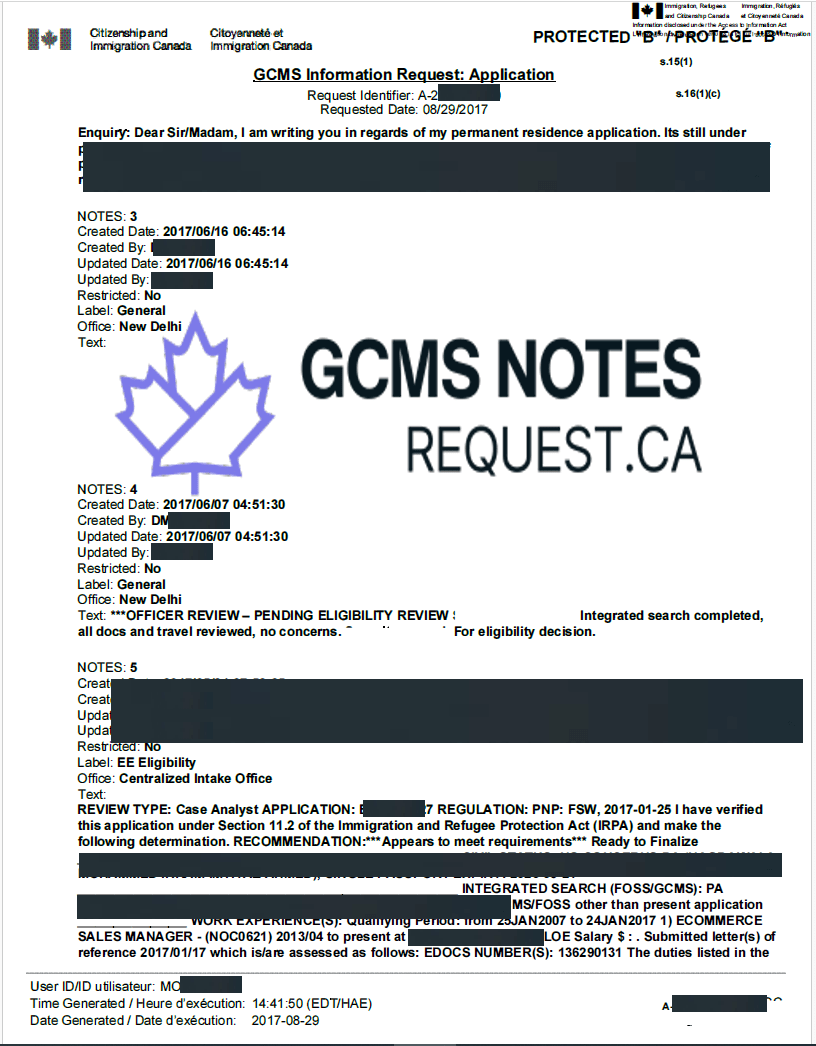
The image above shows a typical GCMS notes page. Often each report runs 5 to 50 pages depending on the complexity of your application and how long it has been processing. The format stays consistent across all application types, though the specific assessments vary. To see a detailed walkthrough of what each section contains, visit our GCMS notes sample page.
IRCC vs CBSA GCMS Notes: What Is the Difference?
GCMS notes can come from two government departments, and each holds different parts of your file.
- IRCC notes cover the immigration processing side: application status, eligibility assessments, officer comments, document reviews, and processing decisions.
- CBSA notes cover the security and admissibility side: background screening, security checks, and information that IRCC sometimes redacts before releasing to you.
Many applicants order both for the most complete picture, especially when they suspect that security screening is causing a processing delay. Additionally, you can also order your entire case file from IRCC, which includes copies of every form and document you submitted alongside the officer notes. For a full comparison of what each record type contains and which one to choose, see our guide on IRCC vs CBSA GCMS notes.
When Should You Request GCMS Notes?
Most people order GCMS notes for one of four reasons.
Application delays are the most common trigger. For instance, when months pass without updates from IRCC, GCMS notes show exactly where your file sits and what is causing the hold-up. This may be because of a pending background check, a missing document, or simply a queue. If your application has gone beyond expected processing times, your notes reveal the specific stage that is taking longer. For current processing time information, visit our GCMS notes processing time page.
Visa refusals are the second most common reason. The refusal letter from IRCC lists broad categories like “purpose of visit” or “travel history,” but GCMS notes reveal the officer’s specific concerns and reasoning. This information helps to turn your reapplication from guesswork into targeted problem-solving. To learn more about step-by-step reapplication strategy, see our guide on GCMS notes after a visa refusal.
Some applicants also order notes for general status checks, to confirm that all background checks have passed before a final decision. While others use them for legal preparation, providing their immigration lawyer or RCIC with a complete record of the assessments carried out on their file. For guidance on what to do once you have your notes, see our page on what to do after receiving your GCMS notes.
Who Can Request GCMS Notes?
Anyone who has a UCI (Unique Client Identifier) from IRCC can request their GCMS notes. This includes Canadian citizens, permanent residents, temporary residents, and foreign nationals who have applied for any Canadian visa or immigration program. You do not need to be in Canada to order since the entire process happens online, and GCMS Notes Request handles requests from applicants worldwide. For details on how the process works from outside Canada, see our guide on ordering GCMS notes from outside Canada.
How Do You Get Your GCMS Notes?
You obtain GCMS notes by submitting an access to information request under Canada’s Privacy Act. This is called an ATIP request (Access to Information and Privacy). GCMS Notes Request handles this entire process on your behalf. Once you provide your details, complete payment and sign a GCMS notes consent form, you’ll receive the notes as a secure PDF once the government releases them.
Your request goes out the same business day, and you can track your GCMS notes through your account. The standard timeline is 15 to 35 days, though the government can apply extensions in some cases. For a detailed walkthrough of each step, see our guide on how to apply for GCMS notes, and for current service fees, visit our GCMS notes fees page.
See our guide on ATIP and GCMS notes, for a deeper understanding of how the ATIP legal framework connects to GCMS notes.
GCMS Notes for Different Application Types
GCMS notes follow the same format across all application types. Every file includes application status, background check results, and officer notes. What changes is what officers focus on during their assessment, because each visa stream has different eligibility criteria and risk factors.
Visitor visa GCMS notes
Visitor visa GCMS notes centre on two main questions: will this person leave Canada when their visa expires, and can they fund their stay? If your visitor visa was refused, the officer’s notes will show exactly which of these factors raised concern. See our full guide on visitor visa GCMS notes for a detailed breakdown of officer assessments and how to use your notes after a refusal.
Study permit GCMS notes
Study permit GCMS notes show how the officer evaluated your study plan, your acceptance from a Designated Learning Institution (DLI), and whether your financial documentation meets the minimum requirements. If there is a gap between your qualifications and the program level, it will typically appear in the officer’s notes. See our guide on study permit GCMS notes for a full breakdown.
Express Entry GCMS notes
Express Entry GCMS notes display your verified Comprehensive Ranking System (CRS) score, how IRCC confirmed your claimed points, and whether your supporting documents passed verification. Officers check language test scores, education credentials (including ECA results), and work experience claims against the National Occupational Classification (NOC). Any discrepancies between what you claimed in your profile and what was verified will appear here. See our guide on Express Entry GCMS notes.
Permanent residence (PR) GCMS notes
Permanent residence (PR) GCMS notes track your application through each processing stage, from acknowledgement of receipt through to final decision. For instance, they show the status of all four background checks (criminality, medical, security, and info sharing), and flag which ones are complete or still pending. For Provincial Nominee Program (PNP) applicants, the notes also confirm provincial nomination verification. See our guide on PR application GCMS notes.
Citizenship GCMS notes
Citizenship GCMS notes include your residency calculation as assessed by IRCC, citizenship test results (or whether a test was waived), and any holds placed on your file. Officers verify physical presence in Canada using travel history records and may flag absences that affect your eligibility. If your application has been stuck without updates, the notes would also show whether a residency questionnaire or hearing has been triggered. See our guide on GCMS notes for citizenship.
Work permit GCMS notes
Work permit GCMS notes cover the officer’s review of your Labour Market Impact Assessment (LMIA) or LMIA-exempt employer compliance, along with standard eligibility and background checks. For LMIA-based applications, the notes confirm whether the LMIA number was validated and whether the job offer details match. For open work permits, officers verify the basis for exemption. See our guide on GCMS notes for work permits.
For a reference on visa counterfoil codes that appear in your Document Issuance section, see our guide on Canadian visa types and counterfoil codes.
What About CAIPS and FOSS Notes?
Before GCMS existed, IRCC used two older databases – CAIPS and FOSS. CAIPS (Computer Assisted Immigration Processing System) was for visa processing outside Canada, and FOSS (Field Operations Support System) for in-Canada enforcement. However, both systems were fully replaced by GCMS, and all current immigration records now live in the GCMS system.
So, if you search for “CAIPS notes” today, you want GCMS notes. The information type, the request process, and the legal framework are all identical. If you want to get a deeper understanding and detailed comparison, see our guide on CAIPS notes vs GCMS notes.
How Long Do GCMS Notes Take?
Most GCMS notes arrive within 15 to 35 days after submission. The government can apply extensions under the Access to Information Act, which may add 30 to 60 days in some cases. Delays also happen when consent forms have errors or when the government processes a high volume of requests. For current processing averages, visit our GCMS notes processing time page. If your notes are taking longer than expected, see our guide on GCMS notes delay.
Do GCMS Notes Affect Your Immigration Application?
No. Ordering GCMS notes has zero effect on your immigration application. In fact, your records request and your immigration application are completely separate processes handled by different teams. IRCC officers who assess your application do not see that you ordered notes, and it does not influence their decision in any way. Requesting your records is your legal right under Canadian law, and thousands of applicants order GCMS notes every month without any impact on their cases.
How Do You Read and Understand GCMS Notes?
GCMS notes use internal codes, abbreviations, and status fields that can look confusing at first. However, they follow a consistent structure across all application types. Start with the Application Status and Assessments block (Eligibility, Criminality, Medical, Info Sharing, Security), then read the officer Notes section for the most recent entry.
For a complete breakdown of every status code, abbreviation, and officer note label, see our GCMS notes glossary, status codes, and what they mean guide. If you have already received your notes and want to know what steps to take, visit our page on what to do after receiving your GCMS notes.
Frequently Asked Questions
What is the difference between CAIPS and GCMS notes?
CAIPS was the older immigration database that IRCC replaced with GCMS in 2010. The information type is the same; only the system name changed. All current immigration records come from GCMS. See our full comparison of CAIPS notes vs GCMS notes.
What is the difference between CBSA and IRCC GCMS notes?
IRCC notes cover immigration processing: officer assessments, eligibility checks, and processing decisions. While, CBSA notes cover security screening and admissibility reviews. CBSA notes sometimes also contain details that IRCC redacts. See our full comparison of IRCC vs CBSA GCMS notes.
Can I find out the reason for a refusal in GCMS notes?
Yes. GCMS notes contain the officer’s specific assessment and reasoning, which goes far beyond the generic refusal letter. See our guide on GCMS notes after a visa refusal for a step-by-step reapplication strategy.
Does ordering GCMS notes delay my immigration application?
No. Ordering notes has no effect on your file. IRCC officers do not see that you requested notes, and it does not slow down or influence their decision. It is your legal right under Canadian law.
How much do GCMS notes cost?
Service fees vary by record type (IRCC, CBSA, or both). Visit our GCMS notes fees page for current pricing.
Can GCMS notes guarantee application approval?
No. GCMS notes provide transparency into your application, not guarantees. They show you what has happened on your file and help you make informed decisions. But, the immigration officer’s final decision depends on the program requirements and your documentation.
How long does IRCC retain case files?
IRCC retains GCMS records for up to 10 years after the last administrative action on your file. Entire case file documents (forms, correspondence) may have different retention periods.
Order Your GCMS Notes
See exactly what is happening with your immigration file. Visit gcmsnotesrequest.ca to order your GCMS notes from IRCC and get officer-level transparency on your application. Most information held by IRCC can be accessed through GCMS notes. The main exceptions are Cabinet documents and records whose release could affect national security, the economy, federal-provincial relations, or international affairs. For an official explanation of what information may be withheld, refer to IRCC’s access to information guidance.
 English (Canada)
  Français du Canada
  हिन्दी
  ਪੰਜਾਬੀ
  ગુજરાતી
  Español de México
  简体中文
简体中文  العربية
  اردو
اردو  বাংলা
বাংলা  Português do Brasil
  Italiano